



Bid Alerts or Pre-RFP Intelligence? How to Build Your SLED Procurement Tech Stack
septembre 2, 2026Ask a SLED sales leader which procurement tool their team should buy, and the conversation often turns into the wrong debate: this platform versus that one, as if a single subscription could cover an eighteen-month buying cycle. The teams that consistently win state and local government contracts have stopped framing it that way. The better question is not which tool, but which stage each tool covers. The categories are complements, not substitutes, and the strongest stacks give each one a job.
SLED stands for state, local, and education. In this article, it refers to the state agencies, cities, counties, school districts, public colleges and universities, special districts, and other public entities that make up the non-federal government market.
Why One Tool Can’t Cover the SLED Buying Cycle
Many SLED opportunities follow a recognizable progression before they become formal bids, though the visible signals and their timing vary by agency, purchase type, and procurement method. A board discussion may appear six to eighteen months before a solicitation. A capital improvement plan may reference a project one to five years earlier. Budget approvals, contract expirations, and RFIs each leave their own trace on their own clock. And some purchases skip stages entirely; cooperative contracts, renewals, and emergency procurement produce fewer public signals.
The stages that do appear live in different places, and no single tool watches them all. That is the structural reason SLED sales teams end up with a stack rather than a subscription.
Map the Tools to the Buying Stage
The lead times below are directional ranges, not universal procurement timelines. Keep in mind that the date a project first appears, the date funding is approved, and the date an RFP publishes are distinct events that can sit months apart.
|
Signal
|
Possible lead time
|
Where it lives
|
Tool category
|
|---|---|---|---|
|
Board or council discussion
|
6-18 months
|
Agendas, minutes, meeting video
|
Pre-RFP intelligence
|
|
Capital improvement plan
|
1-5 years
|
CIPs, budget books
|
Pre-RFP intelligence
|
|
Budget approval
|
3-9 months
|
Adopted budgets
|
Pre-RFP intelligence
|
|
Contract expiration
|
6-12+ months
|
Contract registries, finance reports
|
Pre-RFP intelligence
|
|
RFI or pre-solicitation notice
|
3-6 months
|
Procurement portals
|
Portals and aggregators
|
|
Formal RFP or bid
|
Immediate
|
Procurement portals
|
Portals and aggregators
|

The table highlights the gap. Most vendors begin monitoring at the final two stages, when an RFI or formal bid is already public. The first four stages (meetings, capital plans, budgets, and contract expirations) represent the part of the cycle that most bid feeds do not consistently cover, and the part where relationships and requirements take shape. For more background on why those early stages matter, read our guide to finding government opportunities before the RFP and our analysis of what late-stage RFP discovery costs BD teams.
The Four Layers of a SLED Tech Stack
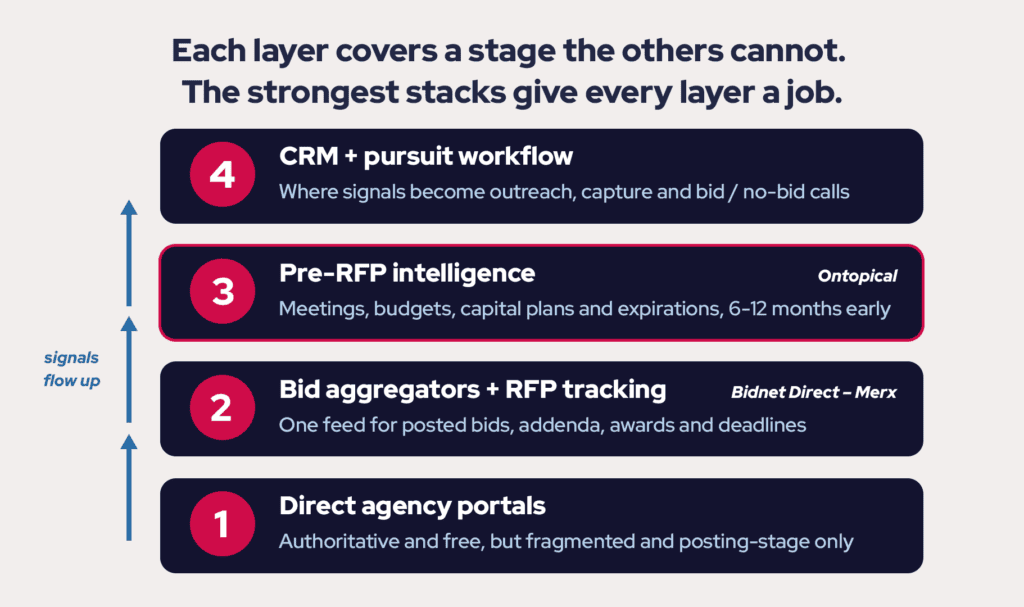
Layer 1: Direct Agency Portals
States, counties, cities, school districts, and other public agencies generally publish formal solicitations through an eProcurement system, purchasing page, cooperative contract, or third-party bid portal, though the source and level of coverage vary by jurisdiction. These sources are authoritative and free, and for a vendor selling to a handful of agencies, checking them directly is workable. Coverage is fragmented across thousands of separate sites, and portals are primarily designed to expose procurement activity once it reaches the public solicitation stage. Some publish forecasts or pre-solicitation notices, but that coverage is inconsistent. Portals are the floor of a SLED stack, not the stack itself.
Layer 2: Bid Aggregators and RFP Tracking Software
Bid aggregators solve the fragmentation problem by helping teams find government contract bids once they are formally posted. Bidnet Direct by SOVRA consolidates solicitations, addenda, and awards into one searchable feed with matched notifications tuned to your industry and territory, backed by more than 20 years of historical solicitation data. Through partnerships with 7,000+ government agencies, opportunities posted by participating member agencies may appear exclusively on Bidnet Direct, alongside broader aggregated bid coverage across the U.S. For Canadian tenders, Merx plays the same role.
This is what RFP tracking software is designed to help with: centralizing posted bids, deadlines, amendments, and notifications, so your team is far less likely to miss a relevant opportunity. What an aggregator is not built to do is see the first four stages of the table. The planning that precedes publication happens in documents no bid feed carries.
Layer 3: SLED-Focused Pre-RFP Intelligence
Those early-stage documents (agendas, minutes, budget books, capital plans, meeting recordings) are scattered across tens of thousands of local sources. Manual monitoring can work for a limited territory, but the workload becomes difficult to sustain as the number of agencies and source types grows. Pre-RFP intelligence platforms exist to do it at scale.
Ontopical by SOVRA is designed for this early stage of the SLED buying cycle. It monitors public-sector sources such as agendas, budgets, plans, minutes, and meeting video transcripts across more than 50,000 agencies in the U.S. and Canada, helping suppliers identify potential projects 6 to 12 months before they become formal RFPs, then connect those signals with agency context and available decision-maker contact information. The platform also includes active solicitation search (integration with Bidnet Direct & Merx), so teams can link early signals with live opportunities in one workflow.
Some teams also license broad, multi-market intelligence platforms spanning federal, SLED, and Canadian government in one subscription. Those make sense when your pipeline genuinely crosses markets. For SLED-only teams, a focused stack typically covers more of the buying cycle for the spend.
Layer 4: CRM and Pursuit Workflow
Discovery tools only pay off when signals become action. The final layer is where your team already lives: the CRM, proposal management, and collaboration systems that turn a flagged opportunity into account research, outreach, and a bid or no-bid decision. Choose discovery tools that feed this layer rather than fight it. Ontopical, for example, integrates with CRMs such as Salesforce, HubSpot, and Unanet, so new leads land where pursuit work actually happens.
How Bidnet Direct and Ontopical Work Together
This is the combination SOVRA’s supplier network is built around, and it reflects how suppliers actually behave. Many use Ontopical to identify and research potential projects early, then use Bidnet Direct or MERX to monitor and respond when those opportunities formally post. Each layer hands off to the next. A board meeting signal becomes a tracked account, a tracked account becomes a matched bid notification, and your team enters the formal competition with context competitors discover on posting day. One of our customers, an engineering and construction firm reports getting three to six months ahead of government RFPs using this early-signal approach.

Four Questions to Ask Before You Buy
- Where are you losing? If you are missing posted bids, start with the aggregator layer. If you are finding bids but losing to better-prepared incumbents, your gap is upstream in pre-RFP intelligence.
- How wide is your territory? Manual monitoring may hold for a limited set of accounts. As agencies and source types multiply, intelligence tooling stops being optional.
- Do you sell beyond SLED? Federal-heavy pipelines change the calculus. SLED-only teams should not pay for coverage they will not use.
- Can your team act on early signals? Pre-RFP intelligence pays off through relationship building months before a solicitation. If nobody owns that motion yet, start with our pre-RFP monitoring checklist.
Example Stacks by Team Size
|
Team situation
|
Recommended stack
|
|---|---|
|
One state, limited accounts
|
Agency portals + CRM
|
|
Several states, many bid sources
|
Bidnet Direct + CRM
|
|
Large SLED territory
|
Ontopical + Bidnet Direct + CRM
|
|
U.S. and Canadian coverage
|
Ontopical + Bidnet Direct + MERX + CRM
|
Cover the Whole Cycle, Not Just the Last Month
The vendors that consistently win SLED government contract opportunities rarely have the single best tool. What they have is a stack that sees the opportunity at every stage: forming in a board meeting, funded in a budget, and finally posted as a bid. Cover the full buying cycle with a stack built for both early discovery and active procurement. Download the free guide, Win 45% More Contracts by Getting Ahead of RFPs, or if you would rather see it live, book a demo of how Ontopical and Bidnet Direct work together.
Frequently Asked Questions
Is Bidnet Direct enough on its own?
For centralizing posted solicitations, amendments, awards, and matched notifications, it is built for exactly that. To see opportunities before they post, pair it with pre-RFP monitoring of meetings, budgets, capital plans, and contract expirations.
Can Ontopical and Bidnet Direct be used together?
Yes. They address different stages of the buying cycle. Ontopical helps identify and research potential projects earlier, while Bidnet Direct helps suppliers monitor and respond to active U.S. solicitations. Ontopical also includes active solicitation search (integrated with Bidnet Direct), so teams can connect early signals with formal opportunities in one workflow.
What is the difference between RFP tracking software and pre-RFP intelligence?
RFP tracking software manages formal solicitations, deadlines, documents, and proposal activity. Pre-RFP intelligence surfaces earlier evidence of demand, such as board discussions, budgets, capital improvement plans, and expiring contracts. They cover different halves of the buying cycle, which is why many teams use both.
Do I need a broad multi-market platform if I only sell SLED?
Usually not. Multi-market platforms earn their cost when your pipeline spans federal and SLED. If your buyers are state and local government and education agencies, a SLED-focused stack puts your budget against the sources that actually precede your RFPs.
What does SLED stand for in sales?
State, local, and education: state agencies, cities, counties, special districts, K-12 districts, and public colleges and universities. For a full primer, read our guide to finding government opportunities in the SLED market.