

Intake
Modernize Procurement Intake with SOVRA Intake
Modernize your Procurement Intake
SOVRA’s Intake module replaces manual, email‑driven requests with a conversational experience that guides users through the submission process, identifies relevant current contracts, routes approvals automatically, and provides real‑time tracking.
Stop Losing Good Procurement at the Starting Line
With SOVRA’s NextGen Intake, You Will…
Decrease procurement
cycle time
Increase spend
on contract
Automate Request
Routing
Provide real-time reporting and visibility
The Hidden Cost of Manual Intake
Most procurement problems don’t start with sourcing. They start at the moment someone submits a request. When procurement requests still live in emails and spreadsheets with limited information, the downstream consequences are predictable: incomplete data, missed approvers, compliance gaps, and delayed approvals. Without a centralized system, procurement teams operate reactively instead of strategically.

The Only AI-Native Intake Platform Built Specifically for Government
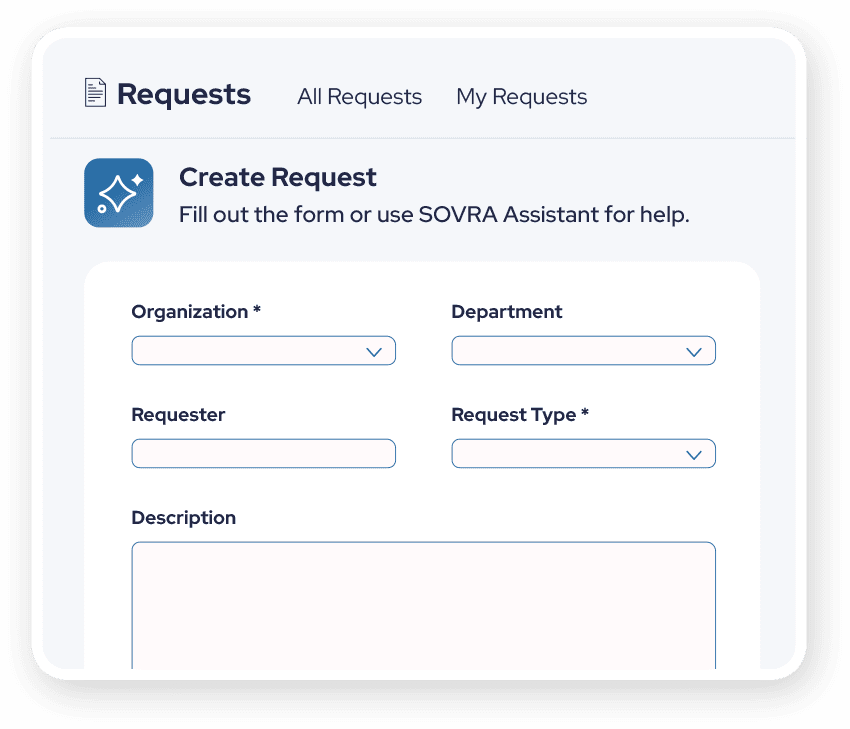
Requestors simply describe what they need in plain language. The AI assistant fills in details, asks follow‑up questions, and ensures each submission arrives complete and accurate.
Every request finds the right approver instantly, based on rules configured by your team. No manual handoffs. No requests sitting in a queue waiting to be assigned.
During submission, the system surfaces existing contracts and cooperative agreements to prevent duplicate spend.
SOVRA Intake handles procurement-related requests, including standard purchases, cooperative buys, sole-source justifications, emergency procurement, contract creation, and more.
Design approval sequences that match your organizational structure. Support single‑approver paths or complex multistep workflows across departments.
Every submission, decision, return, and resubmission is automatically captured with the actor, timestamp, and reason, creating a complete audit trail.
Dashboards provide visibility into pipeline, cycle times, bottlenecks, and potential spend.
Built for Every Request, Every Role
Speed and Simplicity: Describe your need and submit in minutes. The AI assistant guides you and fills in the details, so you always know where your request stands.
Visibility: Track your request status in real time; receive clear feedback if a request is returned.
Organized Dashboard: View all pending requests with full context. Approve or return with a single click and a required reason.
No Email Overload: Notifications keep you informed without burying you in email.
Self‑Service Configuration: Create and adjust request types, approval paths, and organizational settings without IT. Handle cooperative, sole source, emergency, and contract‑creation requests in one workflow.
Audit‑Ready Control: Every configuration change is logged. You always have a compliance‑ready record.
Risk Reduction: Replace fragmented email‑based workflows with a compliant, auditable system. Every request, approval, and return is logged, reducing compliance risks during audits.
Strategic Visibility: Gain a complete view of incoming demand, cycle times, and spend under management, enabling better budgeting and resource decisions.

AI‑First Intake for Government Procurement
SOVRA’s Intake isn’t a generic workflow tool; it is purpose‑built for the complexity of public‑sector purchasing. With AI assistance at its foundation, the Intake module will provide clarity and efficiency across all request types, approval pathways, and compliance requirements.
“This has been the biggest difference. We can now track legitimate requests, explain rejections clearly, and stop wasting time on unclear asks. It’s changed everything.”
Mark Hawks, Chief Assistant Purchasing Agent, Fulton County, GA
Ready to Modernize your Intake?
Schedule a personalized demo and see how SOVRA’s AI‑powered intake can transform procurement requests at your agency.
Common Questions from Construction & Engineering Teams
Procurement intake is the structured process of capturing, evaluating, and routing purchase requests before they move into sourcing, contracting, or purchasing workflows. Good intake management is centralized, structured, automated, and connected to downstream processes.
Beyond inefficiency, manual intake limits visibility. Requestors don’t know where their submission stands, approvers dig through inboxes, and procurement leaders have no reliable record of how decisions were made. Modern intake management replaces these fragmented channels with a digital portal that improves visibility, governance, and speed.
Procurement intake is the front door to the entire source‑to‑contract process. Poor intake cascades into sourcing delays, weak RFPs, and non‑compliant contracts. Modern intake management systems are centralized, structured, automated, and fully connected to the intake‑to‑procure lifecycle. They capture required information up front, automate routing, and provide real‑time visibility. With a centralized front door, adoption increases, and organizations gain more spend under management.
AI guides requestors through required questions, automatically populates fields, and routes the request to the correct approver. This reduces incomplete submissions, accelerates cycle times, and improves accuracy.
Yes. Intake integrates with SOVRA’s source‑to‑contract suite and connects to ERP/finance systems via standard connectors, ensuring approved requests flow seamlessly into purchasing and payment workflows.
The module supports standard purchases, cooperative buys, sole-source justifications, emergency procurement, and contract creation requests. Admins can configure additional request types without IT.
Every submission, approval, return, and resubmission is automatically logged with actor, timestamp, and reason. The system enforces policy compliance, provides real‑time visibility, and maintains a complete audit trail.
Yes. SOVRA Intake is purpose‑built for public ‑sector procurement and aligns with the transparency, fairness, and compliance norms of U.S. state and local governments. It supports FOIA requests and integrates with cooperative purchasing agreements common to the public sector.