


What is the SLED Market? How to Find Government Opportunities Before the RFP
August 25, 2026Most vendors discover a government opportunity when an RFP appears in a bid portal. By that point, the agency may already have identified the problem, discussed the project publicly, secured funding, hired a consultant, and started shaping requirements.
For companies selling into state, local, and education markets, the RFP is important, but it is rarely the beginning of the buying journey.
The better question is:
Which public agencies are planning projects that could become procurement opportunities in the next 6,12, or 18 months?
That is the purpose of pre-RFP intelligence.
What Does SLED Stand For?
SLED stands for State, Local, and Education. It refers to the U.S. public-sector market made up of state agencies, cities, counties, special districts, school districts, and public higher-education institutions.
SLED Market at a Glance

State
State departments, agencies, authorities, and commissions

State
Cities, counties, townships, municipalities, and special districts

Education
K-12 school districts, community colleges, public universities, and other public educational institutions
Although these buyers are often grouped together as “SLED,” they don’t operate as one market.
A state transportation department, a municipal water utility, a county government, a school district, and a public university can all have different purchasing rules, approval structures, fiscal calendars, contract vehicles, and procurement systems.
That complexity is what makes SLED challenging and valuable – for vendors that build a focused sales strategy.
SLED is one market category, but thousands of different buying environments.
How Large is the SLED Market?
There isn’t one universally accepted figure for total SLED procurement spending because estimates vary based on which government entities and spending categories are included.
The more useful measure of SLED’s complexity is its fragmentation.
The U.S. Census Bureau reported 91,438 local governments in 2025, including 3,031 counties, 19,489 municipalities, 16,184 townships, 12,535 independent school districts, and 40,199 special district governments.
The census count does not include every public-school system as an independent government, because some school systems are dependent on state or local governments.
For vendors, this means the opportunity is not “all government.” You need to identify the right agencies, projects, and buying signals for your business.
SLED vs. Federal Government Sales?
SLED and federal government sales share some characteristics, but the buying environments are fundamentally different.
|
Area
|
Federal
|
SLED
|
|---|---|---|
|
Market Structure
|
Nationwide federal frameworks, with agency-specific processes
|
Thousands of state, local, and education buyers with jurisdiction-specific rules
|
|
Procurement Rules
|
Federal statutes, regulations, and agency procedures
|
State statutes, local ordinances, board policies, and entity-specific procedures
|
|
Buyers
|
Federal departments, agencies, and bureaus
|
States, cities, counties, districts, schools, universities and authorities
|
|
Buying Calendars
|
Federal fiscal year runs October 1 – September 30
|
Varies by jurisdiction
|
|
Contract Vehicles
|
Federal schedules, IDIQs, GWACs, BPAs, and agency contracts
|
State contracts, cooperative contracts and local vehicles
|
|
Early Opportunity Signals
|
Agency forecasts, budget requests, acquisition plans
|
Capital plans, budgets, public meetings, grant awards, project studies, and procurement planning
|
The practical difference is straightforward: federal sellers can often prioritize a defined set of agencies and contracting pathways. SLED sellers need to understand buying behavior at the jurisdiction, purchase value, funding source, contract type, and agency policy.
How SLED Procurement Work?
No single process applies to every SLED purchase. Procurement requirements can vary based on jurisdiction, purchase type, funding source, contract type, and agency policy. Still, many public sector purchases follow a pattern similar to:

The RFP or bid is therefore not necessarily the beginning of the buying process. It’s often one of the later visible stages.
Before a solicitation is published, an agency may have already:
- Identified a problem or project
- Included it in a strategic or capital plan
- Requested or allocated funding
- Discussed the initiative in a public meeting
- Conducted a feasibility or needs assessment
- Engaged consultants or technical advisors
- Developed preliminary requirements
- Determined a procurement approach
- Prepared the solicitation
By the time the RFP appears on a procurement portal, much of the underlying decision-making may already be underway.
Vendors that begin research only when an RFP is published may be entering after months of planning have already occurred.
Why the Pre-RFP Stage Matters
Consider a city planning a major wastewater infrastructure project.
A simplified public timeline might look like this:
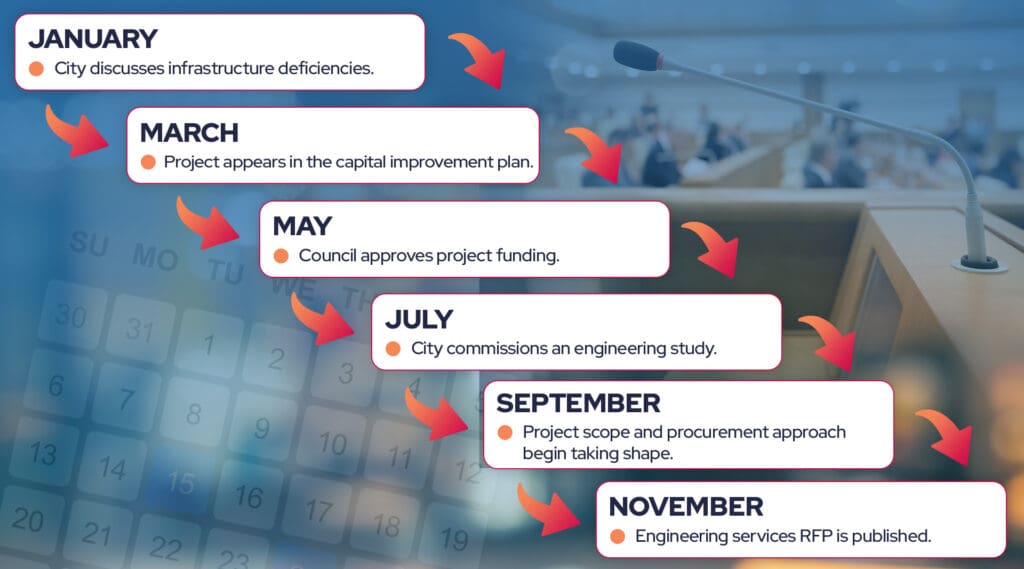
A traditional bid-alert system may first identify the opportunity in November.
A sales team monitoring the agency’s planning and project signals could potentially identify it much earlier. That additional time can be used to:
- Research the agency
- Understand the project
- Identify stakeholders
- Build relationships
- Develop relevant expertise
- Prepare a capture strategy
- Identify partners
- Understand likely requirements
- Prepare compliance documentation
The objective isn’t to bypass procurement. It’s to understand the opportunity before competition becomes visible to everyone else.
7 Pre-RFP Signals SLED Sales Teams Should Monitor
Not every government document signals a future contract. The highest-value comes from connecting multiple signals.
1. Capital Improvement Plans
Capital improvement plans can reveal infrastructure and facility projects before procurement begins. Look for:
- New construction
- Renovations
- Infrastructure replacement
- Technology modernization
- Transportation projects
- Water and wastewater projects
- Public safety investments
2. Budget Documents
Budgets can show where an agency intends to allocate money.
A budget allocation doesn’t necessarily mean a procurement is imminent, but it can establish that funding exists for a future initiative.
3. City Council and Board Meetings
Public meeting agendas, minutes, and recordings can reveal discussions that don’t appear in procurement databases. Examples include:
- Project approvals
- Funding discussions
- Consultant appointments
- Technology initiatives
- Infrastructure priorities
- Contract strategy
4. Strategic Plans
Strategic plans can identify longer-term priorities that eventually become funded projects.
5. Feasibility Studies and Needs Assessments
These are particularly valuable because they indicate that an agency has moved beyond identifying a problem and is beginning to determine how to address it.
6. Consultant Engagements
When an agency brings outside expertise to assess, design, or plan a project, it can be an important indicator that additional procurement activity may follow.
7. Procurement Planning and RFIs
RFIs and other procurement-planning activities indicate that an agency is moving closer to a formal purchasing process.
Not All Pre-RFP Signals Are Equal
A strong SLED strategy does not treat every government meeting or budget line as a qualified opportunity.
Instead, look for evidence of progressions:
Problem -> Priority -> Funding -> Project -> Scope -> Procurement
|
Signal
|
What it tells you
|
Potential value
|
|---|---|---|
|
Agency discusses a problem
|
A need exists
|
Early
|
|
Strategic plan identifies initiative
|
A priority established
|
Early
|
|
Capital plan includes project
|
A project has been identified
|
High
|
|
Funding is approved
|
Resources may be available
|
Very High
|
|
Feasibility study begins
|
The solution is being shaped
|
Very High
|
|
Procurement planning begins
|
A purchase may be approaching
|
Critical
|
|
RFI/draft specifications
|
Procurement is taking form
|
Critical
|
|
RFP published
|
Competition is public
|
Late
|
The best early opportunities are not isolated signals. They are connected signals that show an agency moving from a recognized problem toward a funded and defined purchase.
Who Influences a SLED Purchase?
One of the biggest mistakes in government sales is treating the procurement office as the only buyer. Procurement manages the purchasing process, but the department that owns the problem often helps define what the agency ultimately needs.
Depending on the purchase, stakeholders can include:
- Department leaders and Program managers
- IT leadership
- Public works and engineering teams
- Finance and budget teams
- Procurement officers
- Consultants and technical advisors
- City councils, governing boards, or school boards
- Other technical or operational stakeholders
The specific decision-making structure varies by agency and purchase.
That’s why pre-RFP research should focus on the project, the agency’s public priorities, the likely stakeholders, and the approved path to purchase – not just a procurement contact list.
SLED Contract Vehicles and Cooperative Purchasing
Not every SLED purchase requires a new, standalone RFP.
Depending on the jurisdiction and purchase, eligible agencies may buy through an existing state contract, cooperative contract, local agreement, or other authorized purchasing vehicle.
Common cooperative purchasing programs include:
- NASPO ValuePoint
- Sourcewell
- OMNIA Partners
- TIPS
For example, NASPO ValuePoint uses a Lead State model and maintains participating addenda that determines how contracts are made available in participating jurisdictions.
For vendors, cooperative contracts can expand the number of public agencies they can potentially sell to without requiring every agency to conduct the same competitive procurement from scratch.
But there is an important distinction: A cooperative contract does not eliminate the sales process.
Your company still needs to:
- Be eligible to participate
- Meet the applicable contract requirements
- Understand which agencies can use the vehicle
- Build awareness among potential buyers
- Win the agency’s business
The procurement mechanism may be different, but demand still needs to exist.
How to Build a SLED Sales Strategy
A scalable SLED strategy starts with focus.
Step 1: Choose a focused market
Start with the problem, buyer type, and geography where your solution has the strongest fit.
For example:
Water infrastructure solutions → Municipalities utilities → Western U.S. cities and special districts
This is far more actionable than targeting “Government → All agencies.”
Step 2: Build a prioritized agency list
Prioritize agencies using criteria such as:
- Geography and service territory
- Population
- Budget and capital-plan activity
- Existing infrastructure
- Historic projects and contract activity
- Strategic priorities
- Procurement behavior
Step 3: Learn how each agency buys
For each priority agency, identify:
- Procurement rules
- Contract vehicles
- Procurement portal
- Fiscal calendar
- Governing body
- Relevant departments
- Existing vendors
- Contract expiration dates
Step 4: Monitor Early Project Signals
Track the public information that can reveal projects before formal procurement.
Focus on signals connected to your ICP rather than trying to monitor everything.
Step 5: Build relationships before the RFP
Use early intelligence to understand:
- Who owns the project
- What problem they’re solving
- How the project is funded
- What stage it is in
- Who else may be involved
Engage through permitted, transparent channels. Do not seek nonpublic information or attempt to shape a solicitation improperly. Then engage appropriately and compliantly.
Step 6: Shift to capture and bid execution
Once the solicitation is published, shift from opportunity discovery to capture and bid execution.
How Ontopical supports pre-RFP discovery
Traditional bid intelligence starts when a solicitation becomes visible.
Ontopical is designed to monitor public-sector activity to identify early signals of upcoming government projects, helping sales teams find opportunities while they’re still being planned and scoped.
It moves your visibility upstream.
Instead of asking: “What government bids are open today?” Teams can also ask: “Which agencies are planning projects that fit our solution, and what signals show those projects are moving toward procurement?”
This is where Ontopical fits into the SLED sales workflow.
The Bottom Line: Don’t Start at the RFP
The SLED market isn’t difficult because there aren’t enough opportunities. It’s difficult because there are thousands of agencies, different procurement environments, different buying cycles, and layers of public information that can reveal an opportunity long before an RFP appears.
The RFP is important. But it shouldn’t be the first time your sales team learn about the project.
The earlier you understand what an agency is planning to buy, the more time you have to prepare for the competition.
FAQ
What does SLED stand for?
SLED stands for State, Local, and Education. It refers to U.S. government buyers including state agencies, local governments, school districts, public universities, and other public-sector entities.
How do you sell to SLED government agencies?
A successful SLED sales strategy typically combines focused account selection, understanding agency procurement processes, relationship development, contract-vehicle strategy, and monitoring opportunities before formal solicitations are released.
How do you find SLED government opportunities?
Vendors can monitor government procurement portals, bid notifications, cooperative contracts, agency websites, and other procurement resources. A broader pre-RFP strategy also monitors budgets, capital plans, meetings, project documents, and other public signals that can indicate future procurement.
How do you find SLED opportunities before an RFP?
Look for signals such as capital improvement plans, budget allocations, council and board discussions, strategic plans, feasibility studies, consultant engagements, project approvals, and procurement-planning activity.
What are SLED contract vehicles?
SLED contract vehicles include state contracts, local contracts and cooperative purchasing agreements that can provide eligible government agencies with established purchasing mechanisms. Examples of cooperative programs include NASPO ValuePoint, Sourcewell, OMNIA Partners and TIPS.
Do SLED agencies always issue an RFP?
No. Procurement requirements vary by jurisdiction, purchase type, dollar threshold and applicable contract vehicle. Some purchases may use existing contracts or other permitted procurement methods instead of a new competitive solicitation.
How long does it take to sell to SLED?
There is no universal SLED sales-cycle length. Timing can range from relatively quick purchases to complex projects that take many months or longer. The procurement method, funding status, project complexity, agency and applicable rules all affect timing.
What is pre-RFP intelligence?
Pre-RFP intelligence is information about a potential government purchase before a formal solicitation is published. It can include project plans, budgets, meeting discussions, funding decisions, feasibility studies, procurement planning and other signals that indicate an agency may eventually go to market.